S&U Plc – Credit Where Credit Is Due

Disclaimer: I have a very material personal interest in S&U Plc shares. A portfolio I help to manage has a very large weight in S&U Plc shares. Hence, I cannot help but be biased. Please do your own research – my projections are mine alone.

Elevator Pitch

I’m a firm believer that, if your stock idea is a solid one, you should be able to explain it in one minute. No bells and whistles, no complications. So here goes:

S&U is a financial holding company with two divisions. The dominant one is Advantage Finance, which lends money to car-buyers with imperfect credit histories.

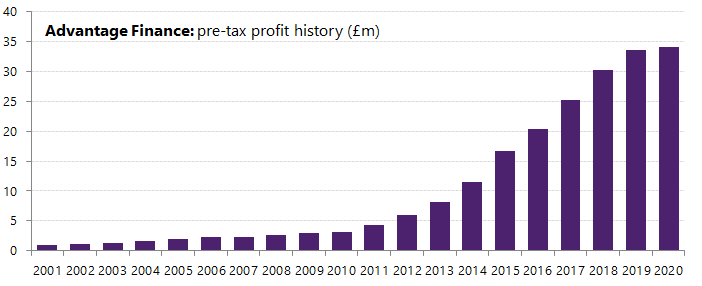
This is an inefficient and hands-on market: you have to actually price for risk and be selective with borrowers. But it’s also very lucrative: since foundation in 1999, Advantage has grown profits every year at a 20%+ clip. Return on capital over the last decade is consistently 16-17%.

Management and their families own half of the outstanding shares, and you can tell from the way S&U is run. The company is fair to its customers in a space where many are not, and the balance sheet is conservative. Their 18% annual total shareholder return over the last two decades is not built on leverage, but on underwriting quality. And – no surprise – they reward shareholders with large dividends, even while the group is growing.

You get all of this at a 7.3x historic P/E, or a smidge over net asset value. This year will be tough – earnings will halve, driven by big, one-off provisions – but the group is then set to rebound and carry on its prior trajectory.

My assessment is that business growth and dividends will drive a 13%+ annual return for investors here, even if S&U were to stay at their current miserly multiple. Those are the investments I love: companies which are fundamentally creating value every year and are cheap to boot.

And why is it cheap? Simple, I think: no broker covers it with any attention, it’s too illiquid for most institutions, and most private investors (rightly) shy away from financials. S&U gets lumped in with the rest, when it’s a diamond in the rough.

Yeah, yeah, I know what you’re thinking. “You must be a bloody fast talker to fit that into a minute”. Luckily, I am.

Advantage Finance

Let’s go into a little more detail on the key division I mentioned above – Advantage Finance.

Advantage Finance is a provider of non-prime, hire purchase car finance: they help people with imperfect credit records buy used cars. They lend around £6,500 on a typical deal for about 4 years. The customer makes a fixed monthly payment and ends up owning the car.

If you’re already dragging your cursor up to the top right of the screen to close the window, give me a little more time. I also hate investing in financials: they’re opaque black boxes. Trust me when I say – like you told your first girlfriend – that S&U is not like the other guys.

Here is why it’s worth giving them at least a couple of minutes:
Continue reading“S&U Plc – Credit Where Credit Is Due”

COVID-19: Time Capsule from October 2020

I’m writing this primarily because I want a marker in the ground that I can look back on in the coming years. I want to have written something public in the moment.

I wrote a letter to my MP on Friday. She is a Liberal Democrat, which seems a delicious irony for a politician supporting policies that are neither Liberal nor Democratic. I told her that I thought our politicians should trust the citizens of this country to manage their own personal risk, as they have been doing every day of their lives, instead of implementing scattershot, reactive, and arbitrary rules. I told her that I thought that the Government instructing us how and in what situations we can mourn our dead or welcome the birth of our children is disgusting.

Today, unfortunately, it was announced that we’ll head into a second national lockdown. The first, in March, closed all non-essential shops, workplaces, schools, and basically inhibited all forms of social interaction with people outside your household. This second will look a little lighter: they want to keep schools open and some semblance of the economy going.

I think the lockdown is stupid. I thought the first one was stupid, and I think the second one is probably more so. I think they are illiberal, heavy-handed policies, implemented by an increasingly authoritarian government aided and abetted by a public which has little respect for our liberty and core freedoms.

That’s the saddest thing about the whole affair, to me: the ease at which most people seem to toss away any conception of their own inherent rights as human beings. Twitter intellectuals and tenured academics alike pontificate on how we could do a better job of containing the virus if we were just a little more stringent with our rules. The British public, doing what they do best, tut at crowds of other people (it’s always other people) and write servile articles about how we bring it on ourselves. If only we listened to the rules and weren’t such naughty schoolchildren, we’d probably have beaten the virus by now and we could be allowed to go back to normal life.

I could write far too much, but Jonathan Sumption lays out the argument against lockdowns more eloquently and much more clearly than I can. You can find plenty of videos of him talking about coronavirus on Youtube. I like this one.

At its core, his argument is that wholescale lockdowns are immoral. People should be free to make up their own minds and manage their own personal risk. Sumption notes that “the problem about law as an instrument… is that individual circumstances are incredibly varied”.

A 22-year old who wants to go and see her ill relative in their house should be allowed to make that choice. A 75-year old who thinks it better to stay indoors, given his risk profile, should also be welcome to. Your risk from the virus is highly variable depending on your personal circumstances: mostly age and health status. But – and this is what is often forgotten – so are your costs from a lockdown. I am not being selfish here. I can sit inside, not lay eyes on another human for 12 weeks and be completely content. But we are already seeing the enormous damage to mental health in people less antisocial than me. All of these diffuse costs are ignored and sacrificed on the altar of getting the rate of coronavirus infections down.

I don’t want to turn this into a treatise, because I am not adequately equipped with the facts. Wherever I look on the internet I see cherry-picked data, often with subtly different definitions. Usually, the interpretation of that data either strongly supports or strongly opposes current policy. I could copy and paste some charts to support my point of view, but I would be lying to my future self when I read this back.

The hard truth is that I have to go on gut. I have to synthesise scattered bits of biased information and try to form my own view. No-one is giving me anything like a balanced picture. Not a single journalist at the press conference asked Boris Johnson any question which was remotely sceptical of lockdowns; all were, instead, wondering why they did not do it sooner. The estimates of fatality rates are so wide you could drive a truck through them. Evidence on the persistence of antibodies and immunity morph into discussions about t-cells and other forms of immunological response, and I don’t pretend to be a biologist or epidemiologist. Fundamental differences in countries, populations, and responses seem to make any reasoned analysis incredibly difficult.

Continue reading“COVID-19: Time Capsule from October 2020”